
During a recent meeting with Donald Trump, Hungarian Prime Minister Viktor Orbán secured exemptions from US sanctions on Russian energy supplies in exchange for massive American purchases five months before Hungary’s difficult election. On 7 November 2025, the BBC reported that Viktor Orban obtained a one-year exemption from sanctions on Russian oil, gas, and nuclear supplies, but committed Hungary to purchasing up to 10 small modular nuclear reactors worth $10–20 billion, $600 million in US LNG, and $114 million in nuclear fuel rods. The article begins:
On the surface, the Hungarian prime minister’s trip was exactly what he went to Washington for: luxuriant praise and an exemption from sanctions on Russian oil, gas and nuclear supplies. And all that just five months out from a difficult election. Look closer, however, and the picture is less clear cut. The US side struck a hard trade deal — and an expensive one for Hungary. And there’s no progress on Viktor Orban’s biggest headache: ending the war in neighbouring Ukraine, and with it the long shadow the conflict casts over Hungary. Let’s look first at Orban’s key win — an exemption from US sanctions, which a White House official told the BBC was time-limited to one year, although Péter Szijjártó, Hungary’s foreign minister, said would be indefinite.
Key Points
- A White House official confirmed the exemption is time-limited to one year, though Hungarian Foreign Minister Péter Szijjártó claimed it would be indefinite, with the timing clearly designed to help Orban win the April election.
- Hungary and Slovakia together paid Russia $13 billion for oil between the February 2022 full-scale invasion of Ukraine and the end of 2024, with Hungary continuing to buy Russian gas through the Turkstream pipeline using a Bulgarian loophole.
- In exchange for the exemption, Hungary committed to purchasing up to 10 small modular nuclear reactors from the US, valued at $10–20 billion; $600 million in LNG; $114 million in nuclear fuel rods; and $100–200 million in spent fuel storage technology.
- Orban failed to secure the reintroduction of the US-Hungary dual taxation system, which was abolished in 2022, or a new date for a potential Trump-Putin summit in Budapest as part of efforts to end the Russia-Ukraine war.
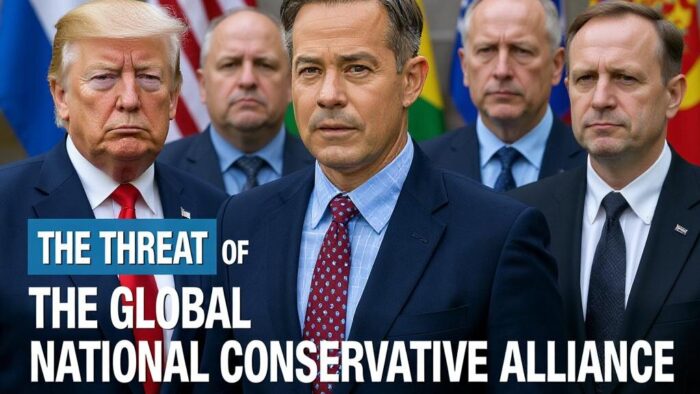
Viktor Orbán and the Global National Conservative Alliance: Building a Transnational Network
Viktor Orbán has emerged as the central figure coordinating a transnational network linking American conservatives with European far-right movements through ideological commitment to national sovereignty and opposition to supranational governance. The Patriots for Europe alliance champions a “Europe of nations” grounded in Christian heritage, positioning Hungary as the operational hub for this expanding coalition. Beyond formal political structures, Hungary deploys institutional infrastructure to amplify this network.
The Mathias Corvinus Collegium, a government-backed facility that received over €6 million to influence European policymakers, hosts prominent American conservatives and academics who reinforce the ideological narrative of “illiberal democracy” as a successful alternative to Western liberalism. Through CPAC events in Budapest—held annually to cement transatlantic bonds—Orbán declares Hungary “healed” of progressive dominance while far-right leaders express solidarity with his Christian values.
This influence architecture operates across multiple channels and extends beyond Europe. According to Balkan Insight, the Batthyany Foundation channels billions in public money to support populist radical forces while facilitating coalition-building under Fidesz leadership. The network encompasses media outlets, think tanks, and political organizations that disseminate illiberal narratives across Central Europe, the European Union, and increasingly the Western Hemisphere. Orbán has developed a near cult-like following on the European far right through consistent electoral victories and substantial resource investment, though his ambitions remain constrained by Hungary’s small size and deepening isolation from EU mainstream politics.
Hungary’s transformation into this influence epicenter reflects broader ideological realignment within global conservatism. The depth of relationship between populist right movements in Europe and the Trump administration was underscored when Trump praised Orbán in a video message as “a great man and a very special person”, cementing the transatlantic alliance at the highest political levels. American Heritage Foundation leaders and conservative intellectuals have championed Hungary as an “inspiration” for institutional capture and media control strategies.
This represents a significant departure from traditional Reagan-era conservatism toward nationalist, protectionist agendas centered on cultural warfare against progressive globalism. The network continues expanding its reach into Latin America and other regions through affiliated organizations like Foro Madrid, demonstrating Orbán’s ambition to establish a global conservative movement organized around Christian nationalist principles and opposition to liberal democracy.
External References:
- To survive, Orban is plotting a far-right takeover of Brussels — Al Jazeera
- Hungarian PM Extends Influence Network in Europe While Clamping Down at Home — Balkan Insight
- CPAC comes to Europe as alliance between Trump White House and international right grows — CBS News
Disclaimer: The Global Influence Operations Report (GIOR) utilizes AI throughout the posting process, including the generation of summaries for news items, introductions, key points, and, often, the “context” section. We recommend verifying all information before use. Additionally, all images are generated using AI and are intended solely for illustrative purposes. While they represent the events or individuals discussed, they should not be interpreted as real-world photography.







 PREVIOUS POST