
Poland’s right-wing is fragmenting as new radical parties challenge Law and Justice’s dominance. On 2 December 2025, The European Conservative reported that PiS had fallen below 30 percent support, while Confederation stabilized between 10–15 percent, and the Crown party, led by Grzegorz Braun, rose to 9 percent. The article begins:
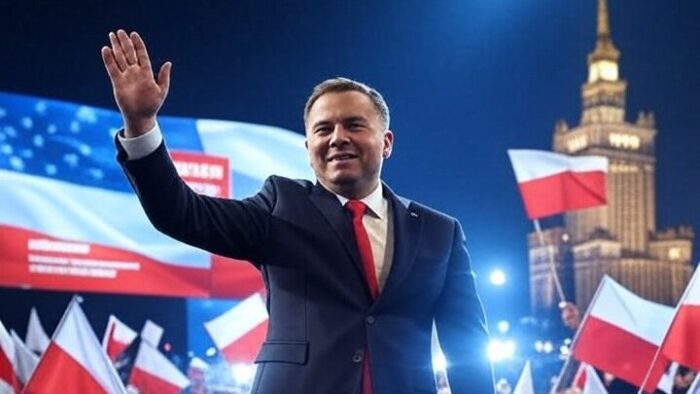
As the centrist-liberal camp around Donald Tusk quietly reconsolidates power, the Polish Right is fragmenting. Law and Justice (PiS) is losing its long-standing dominance to younger, more anti-system forces, while a new ultra-radical party—the Crown—threatens to splinter the conservative camp and even hand the next election to the left-liberals. As the first half of the parliament’s term ends, the right-wing momentum that seemed so strong just a few months ago—when the presidential elections were won, against all odds, by the formally non-partisan national conservative Karol Nawrocki—has visibly stalled.
Key Points
- The Confederacy of the Polish Crown, led by Grzegorz Braun, achieved its first significant success when Braun won 6 percent in presidential elections after leaving the Confederation in January 2025, with party support rising to around 9 percent in recent polls through anti-EU, anti-Ukrainian, and antisemitic rhetoric.
- Confederation stabilized between 10–15 percent, becoming a serious competitor for PiS after the Third Way dissolved, with parties diverging over the Ukraine war as PiS adopted a pro-Ukrainian stance while Confederation advocated a more assertive transactional approach with anti-Ukrainian rhetoric in social policy and diplomacy.
- Support for parties to the right of PiS just exceeded 20 percent. However, these forces combined won less than 8 percent in 2023, with the prospect of a future PiS-Confederation government growing more fragile as conflict intensifies, while the Crown remains too unpredictable to be a viable coalition partner.
- President Karol Nawrocki remains the only figure commanding broad trust across the fractured conservative camp, nominated by PiS but running as a formally non-partisan national conservative, with many seeing the energy he brought to the presidential palace as a potential umbrella under which a future right-of-centre coalition could be rebuilt.
Poland’s Rising Role in the Global National Conservative Alliance
Poland has emerged as a pivotal force within the Global National Conservative Alliance (GNCA), a coalition uniting right-wing movements worldwide under shared principles of national sovereignty, cultural identity, and opposition to global institutions. The Law and Justice party (PiS) serves as a driving force in this alliance, promoting traditional Catholic values while aligning closely with similar movements in Hungary, Italy, and the United States.
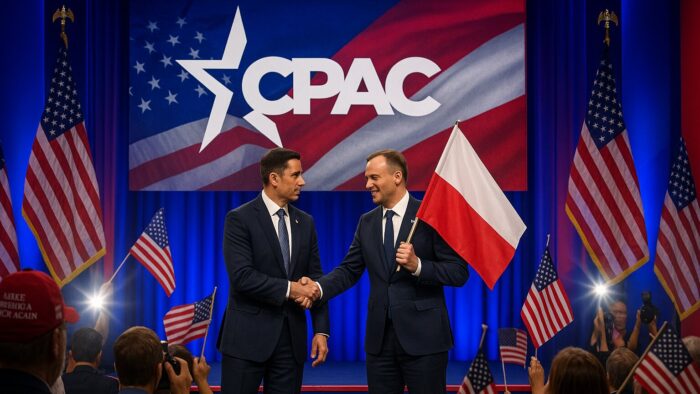
CPAC’s decision to hold its first Polish conference in May 2025 marked a significant milestone, making Poland only the second European country, after Hungary, to host the event. American Conservative Union president Matt Schlapp announced the conference while in Poland to collect an award from conservative broadcaster Republika, invoking Pope John Paul II as a symbol of shared values. NPR reported that CPAC has rebranded itself to celebrate populist approaches while reaching out to conservative movements globally, with the gathering following multiple CPAC meetings in Budapest.
The conference became a platform for unprecedented American intervention in Polish politics. Homeland Security Secretary Kristi Noem publicly endorsed PiS-backed candidate Karol Nawrocki just days before the presidential runoff, promising continued U.S. military presence and American-made equipment if Poland elected him. Former PiS Prime Minister Mateusz Morawiecki, now chairman of the European Conservatives and Reformists, attacked globalists and the EU bureaucracy while calling on Poland to reject immigration distribution policies.
Nawrocki’s subsequent victory with 50.89 percent of the vote demonstrated the enduring appeal of national conservative politics in Poland. The Rosa Luxemburg Stiftung observed that Nawrocki’s campaign represented a strategic shift for PiS, emphasizing social hierarchies and hostility toward outsiders rather than the party’s earlier welfare-oriented messaging. The Hill noted that while Poland’s presidency is largely ceremonial, the veto power gives Nawrocki significant leverage to block judicial and media reforms central to the current government’s agenda. This positions Poland alongside Hungary as a bastion of illiberal democracy within the transatlantic conservative network.
External References:
• Noem urges Poles to elect Trump ally as CPAC holds its first meeting in Poland (NPR)
• Karol Nawrocki elected president of Poland, raises European concerns (The Hill)
• Poland Shifts to the Right (Rosa Luxemburg Stiftung)
Disclaimer: The Global Influence Operations Report (GIOR) utilizes AI throughout the posting process, including the generation of summaries for news items, introductions, key points, and, often, the “context” section. We recommend verifying all information before use. Additionally, all images are generated using AI and are intended solely for illustrative purposes. While they represent the events or individuals discussed, they should not be interpreted as real-world photography.







 PREVIOUS POST