
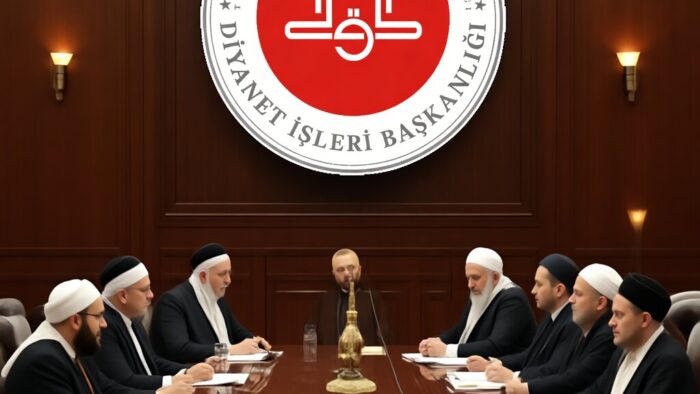
Turkey is using the Diyanet religious institution for influence operations with dramatically increased funding. On 2 December 2025, the Eurasian Times reported that the Turkish Directorate of Religious Affairs now officially plays an active role in pursuing the country’s foreign policy, with the budget increasing from $1.3 billion to $3.18 billion in 2023. The article begins:
It may be noted that “Diyanet”, as a Turkish religious institution, is now officially playing an active role in pursuing the country’s foreign policy. It claims to be a diplomatic counterweight to Western institutions in reshaping global governance narratives. Its activities include the export of Turkish religious narratives, infrastructure development, and clerical training in line with Ankara’s interpretation of Sunni Islam—specifically the Hanafi-Maturidi tradition. It is collaborating with the authorities of the countries in which it works to limit the appeal of Saudi-style Salafism.
Read more: https://www.eurasiantimes.com/turkey-jabs-india-over-kashmir-again-erdogan-india/
Key Points
- Diyanet officially plays an active role in pursuing Turkey’s foreign policy, claiming to be a diplomatic counterweight to Western institutions, with activities including the export of Turkish religious narratives, infrastructure development, and clerical training in line with Ankara’s interpretation of Sunni Islam, specifically the Hanafi-Maturidi tradition.
- The Turkish Directorate of Religious Affairs operates as a state structure directly under the President of Turkey, receiving funds in accordance with budgetary provisions, with the budget significantly expanding from $1.3 billion to $3.18 billion in 2023, according to the latest official release.
- Diyanet manages thousands of mosques domestically and internationally, engaging in educational, charitable, and informational activities, collaborating with authorities in countries where it works to limit the appeal of Saudi-style Salafism and challenge Saudi Arabia’s perceived leadership role.
- Turkey has faced criticism from many Western capitals due to Diyanet’s overseas operations, with growing international scrutiny leading to tighter regulations and oversight, and many Turkish Imams being refused visas in Europe amid concerns about influence activities.
Turkey’s Diyanet: How Ankara Runs Global Influence Operations Through Mosques
Turkey’s Directorate of Religious Affairs (Diyanet) functions as the primary vehicle for Ankara’s transnational influence operations, controlling more than 80,000 mosques domestically while projecting soft power through an expanding international network. Founded in 1924 to bring Sunni Islam under state oversight, the Diyanet underwent a significant transformation after the AKP came to power in 2002, with its budget quadrupled and leadership aligned with government positions. Nordic Monitor reports the institution received $3.7 billion for 2025, surpassing the budgets of multiple Turkish ministries, and aims to reach 2.1 million people abroad through its extensive mosque network.
In Germany, the Turkish-Islamic Union for Religious Affairs (DITIB) manages over 900 mosques as the Diyanet’s principal European branch. The organization maintains structural dependence on the Turkish state, with imams sent from Ankara receiving salaries from the Diyanet or Turkish consulates. Germany’s Ministry of Interior stated that DITIB contributes to opinion formation in Turkish government interests while offering Turkish intelligence many potential informants. A ZDF investigation documented at least nineteen DITIB imams conducting espionage against targets in Germany. The European Journal of Turkish Studies confirms that Diyanet discourse reversed during the 2000s, becoming the AKP’s main ideological instrument in Europe.
Turkey’s religious influence extends beyond Germany into the Western Balkans. Deutsche Welle reported that Diyanet funded the Namazgah mosque in Tirana with €30 million, securing board influence and appointing a Turkish imam. Cultural anthropologists describe this as “infrastructure imperialism,” with Turkey overtaking Saudi Arabia as the leading funder of Balkans mosques following Erdogan’s rise. The Diyanet also operates through the Belgian Diyanet Foundation controlling approximately 70 mosques, while the Diyanet Center of America oversees numerous US mosques to influence Turkish-speaking populations. The Middle East Forum notes that European intelligence agencies have investigated Diyanet mosques for espionage operations targeting critics of the Erdogan government, prompting Western nations to implement measures curbing foreign religious interference.
External References:
• Erdogan’s notorious religious authority eyes global expansion — Nordic Monitor
• Transformation of the Turkish Diyanet both at Home and Abroad — European Journal of Turkish Studies
• Diyanet Serves as Tool for Turkish Soft Power in Germany — Middle East Forum
Disclaimer: The Global Influence Operations Report (GIOR) utilizes AI throughout the posting process, including the generation of summaries for news items, introductions, key points, and, often, the “context” section. We recommend verifying all information before use. Additionally, all images are generated using AI and are intended solely for illustrative purposes. While they represent the events or individuals discussed, they should not be interpreted as real-world photography.









 PREVIOUS POST